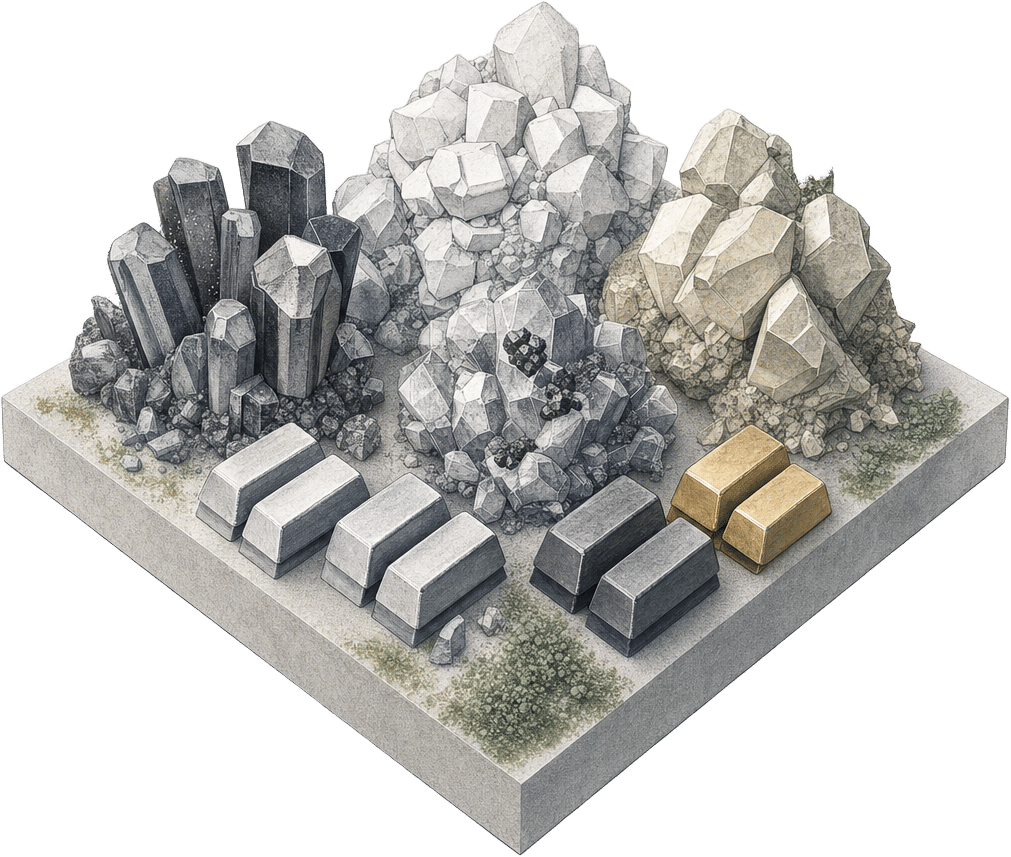
Conflict minerals are metals and other resources that are extracted and sold to fund ongoing armed conflicts, human rights abuses, and other acts of violence. While they come from a multitude of countries in regions ranging from South America to the Middle East, the majority are mined in the Democratic Republic of the Congo (DRC) and surrounding nations like Angola, Rwanda, and the Central African Republic. Today, conflict minerals are largely synonymous with the acronym "3TG," which stands for tantalum, tin, tungsten, and gold. These four minerals are frequently sourced from the DRC and other surrounding African countries, where heavily armed militias use mining profits to fuel campaigns of violence and brutalize civilians. Beyond their role in funding these organizations, 3TG minerals have also been linked to forced labor, child labor, and significant ecological damage in the region. In recent decades, major governments, nonprofit organizations, and industry trade groups have undertaken serious efforts to address the presence of conflict minerals in global supply chains. Legislation like the U.S. Dodd-Frank Act and the EU Conflict Minerals Regulation has promoted responsible sourcing practices by requiring importers to carry out due diligence and meet specific reporting requirements.
In 2017, the European Union passed a new conflict minerals law. According to the European Commission, the EU's Conflict Minerals Regulation was enacted to stop these resources from being exported to the EU, to prohibit EU smelters and refiners from using minerals extracted from conflict zones, and to prevent the abuse and exploitation of mine workers in these regions. The regulation entered into force on January 1, 2021. It requires EU importers of tantalum, tin, tungsten, and gold to fulfill specific due diligence requirements so that their sourcing practices are not perpetuating violence and exploitation in these dangerous, war-torn regions. To do this, importers must adhere to a five-step framework set forth by the Organisation for Economic Co-operation and Development (OECD) in a document titled "Due Diligence Guidance for Responsible Supply Chains from Conflict-Affected and High-Risk Areas."
The United States regulates conflict minerals through Section 1502 of the Dodd-Frank Wall Street Reform and Consumer Act of 2010. Also known as the Conflict Minerals Rule, Section 1502 requires in-scope companies to conduct several due diligence measures. These include carrying out a reasonable country of origin inquiry (RCOI) to determine whether any of the 3TG minerals incorporated into their products originated from the DRC or other adjacent conflict zones, and submitting a conflict minerals report to the Securities and Exchange Commission. If the RCOI finds that minerals were sourced from the DRC or any neighboring countries, the firm must then determine the original source of the raw materials and ascertain their chain of custody. Companies that do not adhere to the Conflict Minerals Rule may face consequences from the SEC, including fines, penalties, and even legal repercussions.
While a number of other countries have established guidelines for responsibly sourcing 3TG minerals and maintaining ethical supply chains, those guidelines are largely non-binding. China, for example, launched the Due Diligence Guidelines for Responsible Mineral Supply Chains in 2015 to serve as a framework for businesses seeking to mitigate risks and align with global standards. Other nations, including Canada, Australia, and Japan, have adopted similar guidance to promote responsible sourcing that relies on comprehensive due diligence practices. The table below summarizes how the major regimes compare.
| Country / Region | Law / Framework | Key Requirements |
|---|---|---|
| United States | Dodd-Frank Section 1502 (2010) | Mandatory for in-scope companies: RCOI on 3TG, due diligence, and a conflict minerals report filed with the SEC |
| European Union | Conflict Minerals Regulation (2017) | Mandatory for EU importers of 3TG; OECD five-step due diligence, third-party audit, and annual reporting via the EU Due Diligence Portal. In force January 1, 2021 |
| China | Due Diligence Guidelines (2015) | Non-binding framework helping businesses mitigate sourcing risks and align with global standards |
| Canada | OECD-aligned guidance | Non-binding; promotes responsible sourcing built on comprehensive due diligence |
| Australia | OECD-aligned guidance | Non-binding; promotes responsible sourcing built on comprehensive due diligence |
| Japan | OECD-aligned guidance | Non-binding; promotes responsible sourcing built on comprehensive due diligence |
Because of advantageous properties that include strong conductivity and high heat resistance, the 3TG minerals figure heavily in electronic component manufacturing. The four major conflict minerals are found in some of the most critical components in electronics, including parts that go into everything from computers and smartphones to household appliances and medical equipment. Tin, for example, is used in the production of resistors and rechargeable batteries, while tungsten is a key material in transistors, diodes, and certain types of microprocessors. Tantalum, meanwhile, can be found in components ranging from capacitors to inductors to memory chips. While many electronics manufacturers are legally obligated to adhere to either the EU Conflict Minerals Regulation or Section 1502 of the Dodd-Frank Act, others have voluntarily adopted the OECD's Due Diligence Guidance for Responsible Supply Chains from Conflict-Affected and High-Risk Areas.
Since it was founded in 2008, the Responsible Minerals Initiative (RMI) has helped guide companies toward legal and ethical minerals sourcing through instructional documents, third-party assessments, and other resources. One of the organization's most popular tools is the Conflict Minerals Reporting Template (CMRT), a standardized reporting template that importers can use to organize and disclose sourcing information to government agencies and other stakeholders. In October 2024, the RMI introduced the Additional Minerals Reporting Template (AMRT), a more customizable version of the CMRT that allows companies to go beyond 3TG reporting and use the template's fields for other minerals of interest. In addition, the RMI is planning to launch a new version of its Extended Minerals Reporting Template (EMRT) in April 2025 that will encompass four new minerals: copper, graphite, lithium, and nickel. In response to new requirements imposed by the EU Battery Regulation, the forthcoming version of the EMRT will also feature a tab that allows firms to include mine-level facility details.

Z2's Responsible Minerals traces tantalum, tin, tungsten, and gold across your entire BOM and maps the smelters behind each part. Collect, validate, and roll up CMRTs from suppliers so your conflict minerals reporting stays audit-ready.
Get a Demo